

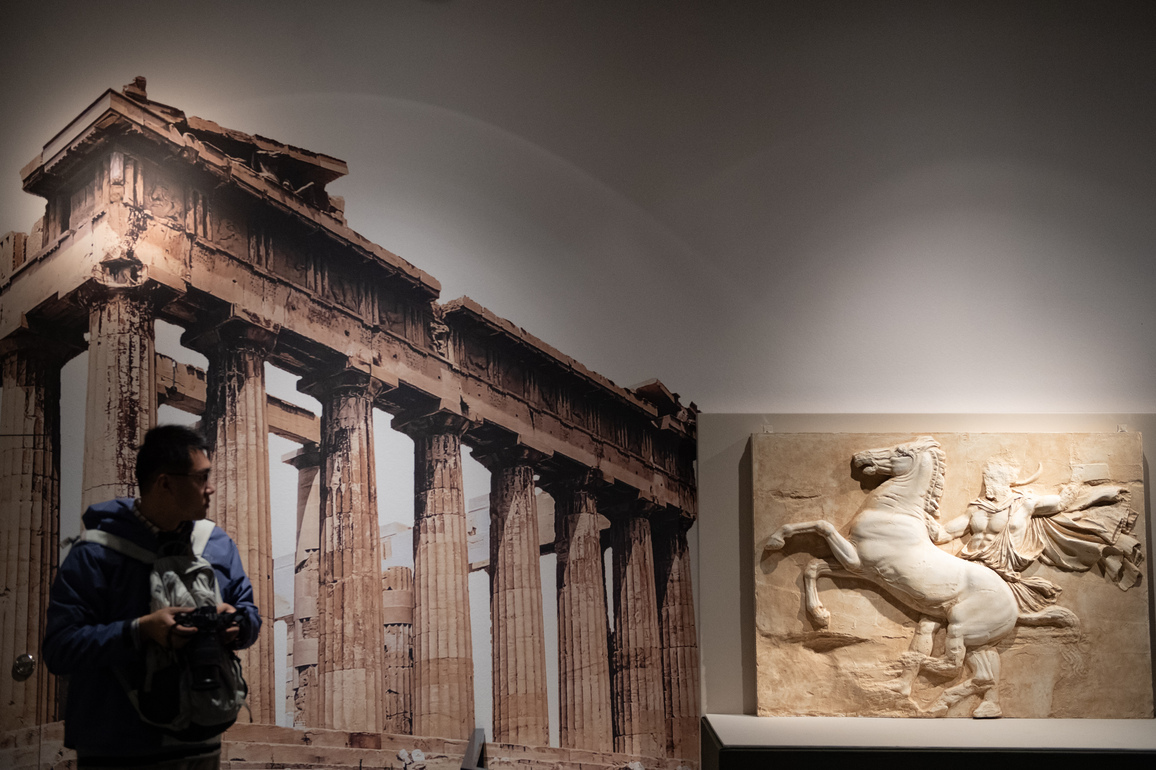
BEIJING, June 8 (Xinhua) -- The Second World Conference of Classics is scheduled to open on Tuesday in Athens, Greece, a year and a half after its first edition.
Themed "Dialogue between Ancient and Modern: Contemporary Inspirations from Classical Wisdom," the conference will dive into the contemporary role and mission of classical studies.
In particular, it will examine how classical wisdom can be revitalized against the backdrop of changes unseen in a century, and how it can be a source of inspiration and guidance for human development and civilizational progress in the contemporary era, according to a press briefing on the conference.
To fully grasp the contemporary significance of classical studies, it is essential to have a clear understanding of what the field actually encompasses.
It is believed that classics, as a modern academic discipline, originated in Europe. It originally emerged as a discipline within the Western intellectual tradition, generally referring to the reading and study of the texts and literature of ancient Greece and Rome.
According to Huang Yang, a history professor at Fudan University, the transformation of classics from a traditional field of learning into a modern academic discipline occurred in the 17th and 18th centuries, amid the height of the European Enlightenment and the onset of the Industrial Revolution.
Western societies, while undergoing rapid development, sought guidance for their future direction, searched for their fundamental values, and attempted to trace the roots of their civilization and progress, as scholars looked to the golden age of ancient Greece and Rome as a vision of the civilization they hoped the modern world might achieve, Huang said.
He also believes Western classics was assigned a special mission: to demonstrate the superiority of Western civilization, as the terms "classical" and "classics" are both derived from the Latin adjective classicus, meaning "belonging to the highest rank."
In the Chinese context, meanwhile, scholars do not place ancient Greek and Roman civilization in a privileged position; rather, they treat it on an equal footing with other ancient civilizations and equally recognize their value for the development of modern society and civilization.
Moreover, China is the earliest civilization in which written culture became the dominant cultural form, which makes the abundance of classical texts a hallmark of Chinese civilization. It also offers a good foundation for the study of classics in China, broad research space and great potential, said Xu Jianwei, a professor with the School of Liberal Arts at Renmin University of China (RUC).
Promoting the study of China's classics and research related to civilizations helps adapt and renew intellectual resources of classical civilizations for the present day, which can provide a solid foundation for concepts that originated from China such as the Global Civilization Initiative and a community with a shared future for humanity, said Xu Xingwu, a professor with the Institute for Advanced Studies in Humanities and Social Sciences at Nanjing University.
Regardless of the study's geographic differences, the study of classics represents a task facing scholars in China and around the world today: to study humanity's classical civilizations and, on that basis, explore their value for the modern world, he said.
The modern world, by contrast, is increasingly shaped by rapid advances in science, technology and productivity, while the rise of the digital and intelligent age has connected people and societies more closely than ever before.
Xu with RUC believes the digital technologies and artificial intelligence (AI) we face today may well be the most important technological advances since the invention of writing, and will inevitably bring about an unprecedented transformation of human culture.
In this context, the ancient world, though seemingly distant, becomes a source of ideas that can help us reflect on and improve our lives today, said Yue Shenghao, a research fellow with the classical civilization research center under the Chinese Academy of Social Sciences.
Lin Zhimeng, a professor with the School of Philosophy of Zhejiang University, unknowingly expounded on Yue's view by citing Plato and Confucianism when speaking of the rat race competition, anxiety, and a loss of meaning triggered by technology, to which, he believes, both Chinese and Western classical thought offer a common remedy: to ask again, "How should a human being live?"
Both Plato and Confucianism contended that the ultimate purpose of human life is not the endless satisfaction of material desires, but the pursuit of complete virtue and the perfection of the soul. Confucius' ideal of staying true to goodness in moments of haste and confusion, and Socrates' philosophical practice of death, both represent a fundamental transcendence of nihilism through a life of virtue, Lin said.
Therefore, in the words of Xu with RUC, the study of classics, with its deeper reflection on the meaning of life, culture, and civilization, can help us better address the challenges posed by digital technologies that transcend national borders and affect the future of humanity.
It can also help us ensure that AI develops in a direction that enhances human well-being and advances human civilization, and ultimately build a more advanced and better intelligent civilization, he said.